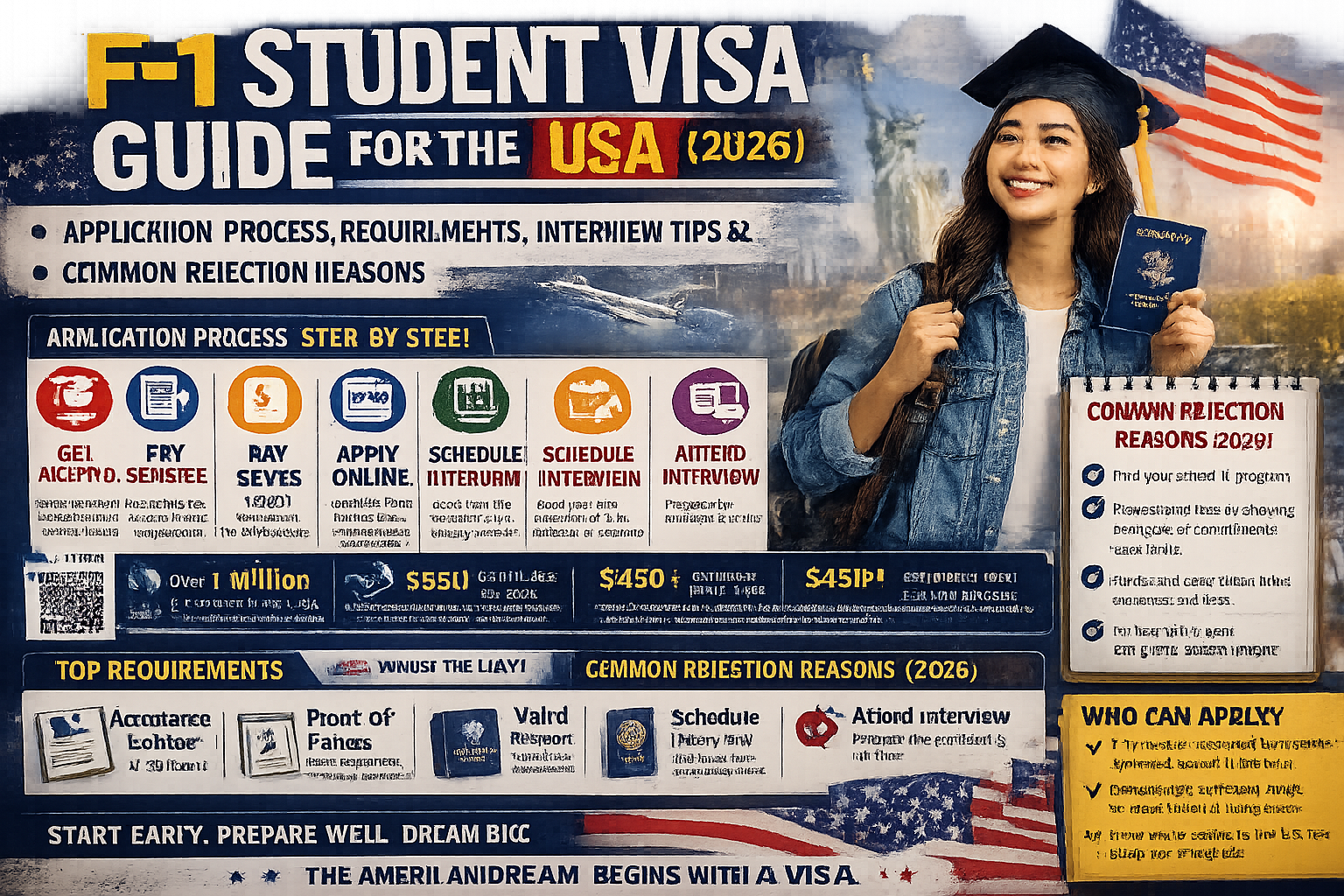
F-1 Student Visa Guide for the USA (2026): Application Process, Requirements, Interview Tips & Common Rejection Reasons

Getting accepted into a U.S. university is a major milestone — but for international students, the journey isn’t complete until you successfully obtain an F-1 student visa. The visa application process can feel overwhelming, especially with strict documentation requirements, in-person interviews, and the constant fear of rejection. Understanding exactly how the process works can make the difference between a smooth approval and a stressful, drawn-out ordeal.

This complete 2026 guide walks you through the entire F-1 visa process — from required documents to interview preparation, financial requirements, and the most common reasons applications get denied.

What Is an F-1 Student Visa?

The F-1 visa is the most common nonimmigrant visa category for international students pursuing full-time academic study at an accredited U.S. college, university, or language training program. It allows students to remain in the U.S. for the duration of their academic program, plus a limited grace period afterward, and includes provisions for limited on-campus and off-campus employment under specific conditions.

The F-1 visa is different from the J-1 visa (used for exchange visitor programs) and the M-1 visa (used for vocational or non-academic training programs), so it’s important to confirm which visa category applies to your specific program before starting the application process.

Step-by-Step F-1 Visa Application Process

Step 1: Get Accepted and Receive Your I-20 Form

Before applying for an F-1 visa, you must first be accepted into a Student and Exchange Visitor Program (SEVP)-approved U.S. institution. Once accepted, the school’s international student office will issue you a Form I-20, which is required to begin the visa application process.

Step 2: Pay the SEVIS I-901 Fee

Before scheduling your visa interview, you must pay the SEVIS I-901 fee, which funds the Student and Exchange Visitor Information System used to track international students throughout their studies. Keep the payment confirmation receipt, as you’ll need to bring it to your interview.

Step 3: Complete the DS-160 Online Visa Application

The DS-160 form is the standard nonimmigrant visa application used for all U.S. visa categories, including F-1. It requires detailed personal information, travel plans, education history, and security-related background questions. After submission, you’ll receive a confirmation page with a barcode, which is required for your interview appointment.

Step 4: Pay the Visa Application Fee

A separate, non-refundable visa application fee (commonly referred to as the MRV fee) must be paid before scheduling your interview. Fee amounts are set in USD but payable in local currency depending on the country.

Step 5: Schedule Your Visa Interview

Appointments are scheduled through your local U.S. embassy or consulate. Wait times for interview slots can vary significantly by country and season, so it’s strongly recommended to schedule as early as possible, ideally as soon as your I-20 is issued.

Step 6: Gather Required Documents

Prepare all required documentation well in advance of your interview date (see full checklist below).

Step 7: Attend Your Visa Interview

During the interview, a consular officer will review your documents and ask questions about your academic plans, financial situation, and ties to your home country to determine visa eligibility.

Step 8: Visa Processing and Passport Return

If approved, your passport with the visa stamp will be returned to you, typically within a few business days, though processing times vary by consulate and may be subject to additional administrative review in some cases.

Required Documents Checklist

Before your F-1 visa interview, make sure you have the following documents organized and ready:

  • Valid passport, with validity extending at least six months beyond your intended stay
  • Form I-20, signed by both you and your designated school official
  • DS-160 confirmation page
  • SEVIS I-901 fee payment receipt
  • Visa application fee payment receipt
  • Passport-sized photo meeting U.S. visa photo requirements
  • Academic documents, including transcripts, diplomas, and standardized test scores (SAT, TOEFL, IELTS, GRE, GMAT, etc.)
  • Proof of financial support, such as bank statements, scholarship award letters, or sponsor affidavits
  • Ties to home country evidence, such as property documents, family ties, or job offer letters, to demonstrate intent to return after your studies

Requirements can vary slightly by consulate, so always check your specific embassy’s official website for any additional documentation requests.

Financial Requirements for F-1 Visa Approval

One of the most heavily scrutinized aspects of the F-1 visa process is proof of sufficient financial resources to cover tuition and living expenses for at least the first year of study, along with reasonable evidence of continued funding for subsequent years. Acceptable financial proof typically includes:

  • Personal or family bank statements showing sufficient liquid funds
  • Scholarship or financial aid award letters from the university
  • Sponsor affidavits of support, often accompanied by the sponsor’s own financial documentation
  • Education loan approval letters from recognized financial institutions

Consular officers pay close attention to whether the source of funds is clearly documented and reasonably sustainable, so sudden large deposits shortly before the interview can sometimes raise additional questions.

F-1 Visa Interview: What to Expect

The visa interview is typically brief, often lasting just a few minutes, but it plays a critical role in the approval decision. Common interview questions include:

  • Why did you choose this particular university and program?
  • How will this degree benefit your career in your home country?
  • Who is funding your education, and how?
  • What are your plans after completing your studies?
  • Do you have family or ties in the United States?

Tips for a Successful Interview

  • Be concise and confident — answers should be clear and to the point, not rehearsed or overly long
  • Know your program details — be able to explain why you chose your specific university and field of study
  • Demonstrate strong home-country ties — family, property, job prospects, or business plans can help establish intent to return after graduation
  • Dress professionally, as first impressions matter in a brief interview setting
  • Bring organized documents, but only present what’s specifically requested by the officer
  • Stay calm under pressure, even if asked unexpected or rapid-fire questions

Common Reasons F-1 Visa Applications Get Denied

Understanding common rejection reasons can help you avoid critical mistakes:

1. Insufficient Ties to Home Country

Consular officers must be convinced that you intend to return home after completing your studies. Weak evidence of future plans, family ties, or career prospects in your home country is one of the most common reasons for denial under immigration law’s presumption of immigrant intent.

2. Inadequate Financial Documentation

Vague, insufficient, or inconsistent financial evidence often leads to denial, especially if the source of funds isn’t clearly explained.

3. Poor Interview Performance

Overly rehearsed answers, inconsistent responses, or inability to clearly explain academic and career goals can raise red flags during the brief interview window.

4. Mismatched Academic or Career Goals

If your stated study plans don’t logically align with your previous education or career trajectory, officers may question the genuineness of your academic intent.

5. Incomplete or Inconsistent Documentation

Missing documents, or inconsistencies between your DS-160 form, I-20, and interview answers, can result in delays or denial.

After Visa Approval: What’s Next?

Once your F-1 visa is approved, keep the following in mind before traveling:

  • You cannot enter the U.S. more than 30 days before your program start date listed on your I-20
  • Carry physical copies of your I-20, financial documents, and admission letter in your carry-on luggage for entry inspection
  • Register with your school’s international student office promptly upon arrival to complete SEVIS check-in requirements
  • Understand F-1 work restrictions, including on-campus employment limits and eligibility rules for Curricular Practical Training (CPT) and Optional Practical Training (OPT) after your studies

Final Thoughts

The F-1 visa process can feel intimidating, but with early preparation, organized documentation, and a clear, confident interview approach, most well-prepared applicants successfully secure their visa. Understanding exactly what consular officers are evaluating — genuine academic intent, sufficient financial support, and strong ties to your home country — allows you to prepare a compelling, honest case for your U.S. study plans.

By starting the process early, staying organized, and practicing clear, confident interview responses, you’ll be well-positioned to turn your U.S. education acceptance into a successful visa approval and the start of an exciting academic journey in 2026.

Every year, hundreds of thousands of international students choose the United States to pursue higher education because of its world-class universities, cutting-edge research opportunities, and globally recognized degrees. If you’re planning to study in the U.S. in 2026, obtaining an F-1 Student Visa is one of the most important steps in your journey. While the application process may seem complicated at first, understanding each stage can significantly improve your chances of approval.

The F-1 visa is a non-immigrant visa issued to international students enrolled in accredited academic institutions in the United States. Whether you’re planning to attend a university, college, language school, or another approved educational institution, you’ll likely need this visa. This guide explains everything you need to know, including eligibility requirements, the complete application process, required documents, interview preparation, common reasons for visa refusal, and practical tips to increase your chances of success in 2026.


What Is an F-1 Student Visa?

The F-1 Student Visa is a non-immigrant visa that allows international students to study full-time at a Student and Exchange Visitor Program (SEVP)-approved institution in the United States. Unlike tourist or business visas, the F-1 visa is specifically designed for educational purposes and remains valid for the duration of your academic program, provided you maintain your student status.

Students holding an F-1 visa can live in the United States throughout their studies, work on campus under certain conditions, and may qualify for Optional Practical Training (OPT) after graduation. Many international students also become eligible for STEM OPT extensions if they graduate from approved science, technology, engineering, or mathematics programs.


Why Study in the USA in 2026?

The United States remains one of the world’s most popular destinations for higher education. American universities consistently rank among the best globally, offering innovative teaching methods, diverse student communities, advanced research facilities, and excellent career opportunities.

Studying in the U.S. also allows students to develop international networks, improve English-language skills, gain practical work experience, and access thousands of scholarship opportunities. Degrees earned from U.S. universities are recognized worldwide, making graduates highly competitive in the global job market.


Who Is Eligible for an F-1 Student Visa?

To qualify for an F-1 visa in 2026, applicants must first receive admission from a SEVP-approved educational institution. After acceptance, the school issues Form I-20, which is required for the visa application.

Applicants must also demonstrate that they have sufficient financial resources to pay tuition fees and living expenses, intend to return to their home country after completing their studies, possess a valid passport, and meet all immigration and security requirements established by U.S. authorities.

Meeting these eligibility criteria is essential before scheduling your visa interview.


Step 1: Receive Admission from a U.S. School

The first step toward obtaining an F-1 visa is securing admission to a recognized U.S. educational institution. Students should carefully research universities based on academic programs, tuition costs, scholarships, campus facilities, location, and career opportunities.

Most universities require applicants to submit academic transcripts, standardized test scores (if applicable), English proficiency test results such as IELTS, TOEFL, or Duolingo English Test, letters of recommendation, a Statement of Purpose (SOP), and application fees.

Once accepted, the institution will issue Form I-20, officially confirming your eligibility to apply for an F-1 visa.


Step 2: Pay the SEVIS Fee

After receiving Form I-20, students must pay the mandatory SEVIS I-901 Fee before applying for the visa interview.

SEVIS (Student and Exchange Visitor Information System) is the database used by the U.S. government to monitor international students throughout their educational journey.

Once the payment is completed, applicants receive a confirmation receipt that must be presented during the visa interview. Failure to pay the SEVIS fee before scheduling the interview can delay or prevent visa processing.


Step 3: Complete Form DS-160

The next step is filling out the online DS-160 Nonimmigrant Visa Application.

This application collects important personal information, including:

  • Passport details
  • Educational background
  • Travel history
  • Family information
  • Employment history
  • Security-related questions

Students should answer every question honestly and accurately because inconsistencies between the DS-160 form and interview responses can negatively affect the application.

After submission, applicants receive a DS-160 confirmation page with a barcode, which is required for the embassy interview.


Step 4: Schedule Your Visa Interview

Once the DS-160 is completed and visa fees are paid, students can schedule an appointment at the nearest U.S. Embassy or Consulate.

Interview wait times vary depending on the country and season. During peak admission periods, appointment slots may fill quickly. Students should therefore begin the application process several months before their intended program start date.

Applicants under certain age categories or renewing previous visas may qualify for interview waivers, depending on current embassy policies.


Documents Required for an F-1 Student Visa Interview

Preparing the correct documents is one of the most important parts of the application process.

Students should carry:

  • Valid passport
  • Form I-20
  • DS-160 confirmation page
  • Visa appointment confirmation
  • SEVIS fee receipt
  • Passport-sized photographs
  • University admission letter
  • Academic transcripts
  • Degree certificates
  • English proficiency test results
  • Financial documents
  • Bank statements
  • Scholarship letters (if applicable)
  • Sponsor documents
  • Affidavit of financial support (if sponsored)

Organizing documents neatly creates a positive impression during the interview and helps answer officers’ questions confidently.


Financial Requirements for an F-1 Visa

One of the most common reasons for visa refusal is insufficient financial evidence.

Applicants must prove they can afford tuition, housing, health insurance, transportation, food, and other living expenses without relying on unauthorized employment in the United States.

Financial proof may include:

  • Personal bank statements
  • Parents’ bank statements
  • Sponsor affidavits
  • Education loan approval letters
  • Scholarship awards
  • Government sponsorship documents
  • Fixed deposits
  • Income tax returns
  • Salary certificates

Visa officers evaluate not only the total amount available but also the credibility and consistency of the financial documents.


English Language Requirements

Most U.S. universities require international students to demonstrate English proficiency before admission.

Commonly accepted exams include:

  • TOEFL iBT
  • IELTS Academic
  • Duolingo English Test
  • PTE Academic

However, English proficiency itself is also evaluated during the visa interview. Students should be able to answer questions naturally and confidently without memorizing scripted responses.

Strong communication skills help convince visa officers that applicants can successfully participate in academic programs taught entirely in English.

The F-1 visa interview is often the most important stage of the application process. In most cases, the interview lasts only a few minutes, so your answers should be clear, honest, and confident. The visa officer wants to determine whether you are a genuine student with legitimate academic goals and whether you intend to comply with U.S. immigration laws.

Some of the most frequently asked questions include:

  • Why do you want to study in the United States?
  • Why did you choose this university?
  • What course are you planning to study?
  • Who will pay for your education?
  • What do your parents do?
  • Why didn’t you choose a university in your home country?
  • What are your plans after graduation?
  • Have you traveled abroad before?
  • Do you have relatives in the United States?

Prepare your answers in advance, but avoid memorizing them word for word. Natural and genuine responses make a much stronger impression.


Best Tips to Pass the F-1 Visa Interview

A successful interview depends on preparation and confidence. Dress professionally, arrive early, organize your documents, and answer only what is asked. Maintain eye contact, speak clearly, and avoid giving unnecessary details.

Remember that visa officers interview hundreds of students every week. They can usually tell when applicants have memorized scripts or are providing misleading information. Be honest about your academic background, financial situation, and future career plans. If you do not understand a question, politely ask the officer to repeat or clarify it instead of guessing.


Can F-1 Students Work in the United States?

Yes. F-1 students are allowed to work under certain conditions, but employment rules are strictly regulated.

During the academic year, students may generally work up to 20 hours per week on campus while classes are in session. During official school breaks, they may usually work full-time on campus if eligible.

Off-campus employment is limited and typically requires authorization. Eligible options may include:

  • Curricular Practical Training (CPT)
  • Optional Practical Training (OPT)
  • Employment based on severe economic hardship (with authorization)

Working without proper authorization can violate visa conditions and may lead to serious immigration consequences.


What Is Optional Practical Training (OPT)?

Optional Practical Training (OPT) allows eligible F-1 students to gain practical work experience in a job directly related to their major field of study.

Most students may apply for up to 12 months of OPT after completing their degree. Those enrolled in qualifying STEM (Science, Technology, Engineering, and Mathematics) programs may also qualify for an additional 24-month STEM OPT extension, allowing up to 36 months of authorized practical training in total.

OPT provides valuable professional experience and can help graduates build careers before pursuing additional education or other immigration options.


How to Maintain Your F-1 Visa Status

Receiving an F-1 visa is only the beginning. Students must continue to follow immigration regulations throughout their stay in the United States.

Important responsibilities include:

  • Remain enrolled as a full-time student.
  • Maintain satisfactory academic progress.
  • Keep your passport valid.
  • Follow all employment regulations.
  • Inform your Designated School Official (DSO) of address or major changes when required.
  • Request authorization before dropping below a full course load if eligible.
  • Keep your immigration documents up to date.

Failure to comply with these requirements may result in the loss of F-1 status.


Common Reasons for F-1 Visa Rejection

Although many applicants receive approval, some are refused because they fail to satisfy visa requirements. Understanding the most common reasons for refusal can help you prepare a stronger application.

Common reasons include:

  • Inadequate proof of financial support.
  • Inconsistent or incorrect information.
  • Weak academic background.
  • Poor interview performance.
  • Inability to explain educational goals.
  • Unclear plans after graduation.
  • Suspicious or fraudulent documents.
  • Failure to demonstrate sufficient ties to the home country.
  • Applying without proper preparation.

A refusal does not necessarily mean you can never receive an F-1 visa, but you should address the issues before submitting a new application.


How to Avoid an F-1 Visa Refusal

Preparation is the best way to improve your chances of success. Choose a university and program that align with your academic history and career goals. Make sure your financial documents are genuine, organized, and sufficient to cover your expected expenses.

Practice answering interview questions naturally, understand your chosen course of study, and be prepared to explain why studying in the United States supports your long-term career objectives. Above all, provide truthful information throughout the process. Even small inconsistencies can affect your credibility.


Important Rights and Responsibilities of F-1 Students

International students enjoy many benefits while studying in the United States, but those benefits come with responsibilities.

As an F-1 student, you generally have the right to:

  • Study full-time at an approved institution.
  • Access university facilities and student services.
  • Work on campus if eligible.
  • Participate in approved internships and practical training.
  • Transfer to another eligible institution, subject to applicable rules.

At the same time, you are responsible for maintaining your student status, obeying federal, state, and local laws, and following all immigration requirements during your stay.


F-1 Student Visa Updates for 2026

Students applying in 2026 should carefully review the latest guidance from their chosen university and the U.S. embassy or consulate where they will apply. Visa procedures, document requirements, appointment availability, and processing timelines can change over time.

Applicants are encouraged to begin preparing several months before their program start date, verify all application details before submission, and monitor official government announcements for any updates that may affect the visa process.


Frequently Asked Questions (FAQs)

How long does it take to get an F-1 visa?

Processing times vary depending on the U.S. embassy or consulate, the season, and individual circumstances. Applying well in advance of your program start date is strongly recommended.

Can I bring my family with me?

Eligible spouses and unmarried children under 21 may apply for F-2 dependent visas, subject to applicable immigration rules.

Can I stay in the U.S. after graduation?

Many graduates apply for Optional Practical Training (OPT). Some may later qualify for other visa categories if they meet the legal requirements.

Is an F-1 visa guaranteed after university admission?

No. Admission to a U.S. educational institution does not guarantee visa approval. Applicants must independently satisfy all visa eligibility requirements during the application process.

Can I transfer to another university?

Yes. Eligible F-1 students may transfer between approved institutions by following the required immigration and school transfer procedures.


Conclusion

Obtaining an F-1 Student Visa is an important milestone for anyone planning to study in the United States in 2026. While the process involves several steps—including gaining admission, receiving Form I-20, paying the SEVIS fee, completing the DS-160 application, attending the visa interview, and demonstrating financial capability—careful preparation can make the experience much smoother.

The key to a successful application is honesty, organization, and a clear understanding of your academic goals. Ensure that your documents are accurate, your finances are well documented, and your interview responses reflect your genuine intention to pursue full-time education. By following the guidance in this article and staying informed about current requirements, you can confidently prepare for your F-1 visa application and take the next step toward achieving your educational and career aspirations in the United States.

Leave a Comment